The Frontier Firm: Why Microsoft's Agentic Shift Changes Everything for Human Success
Microsoft 365 E7 is not another SKU upgrade. It is the infrastructure for a human-led, agent-operated enterprise. And Zensai is building the people layer inside it.
Every enterprise has the same problem right now. They bought the AI. They ran the pilots. They got the demos and the dashboards and the “art of the possible” slide decks. And now the question has changed from “Should we use AI?” to “How do we actually govern this thing at scale?”
That question is harder than the first one. It is also the only question that matters.
Microsoft just answered it with Microsoft 365 E7, a new premium suite that bundles E5 security, Copilot, the Entra identity suite, and a brand new component called Agent 365 into a single platform. The framing is deliberate: this is not “AI bolted onto productivity software.” This is the operating system for what Microsoft calls the “human-led, agent-operated enterprise.”
And Zensai is one of the partners building inside it from day one.
From Sidekick to Workforce
The story of enterprise AI so far has been the story of the sidekick. You type a prompt. The AI suggests a paragraph, summarizes a meeting, drafts an email. Useful. But fundamentally passive. The human drives; the AI rides along.
Agent 365 represents a different model. Agents are not prompts that respond; they are autonomous processes that execute. They take action across systems, access data, make decisions within guardrails, and operate continuously. Microsoft’s own internal deployment already tracks over 500,000 agents, handling everything from sales intelligence to HR self-service.
The shift from “AI assistant” to “AI workforce” sounds like marketing language until you realize what it requires: identity management, compliance controls, security monitoring, and audit trails. Every capability that enterprises already apply to human employees now needs to extend to their digital ones. That is the structural insight behind E7. The same Entra, Defender, and Purview infrastructure that governs your people now governs your agents.
The Trust Layer That Changes the Game
Here is the friction that most enterprise AI discussions skip over.
Building an agent is straightforward. Getting that agent approved, deployed, and governed inside a customer’s tenant is not. Every deployment has historically required a bespoke negotiation: security review, compliance assessment, governance alignment. One customer at a time. One IT team at a time. That process does not scale.
Agent 365 solves this by creating a shared trust architecture at the platform level. When an enterprise deploys Agent 365, it establishes the governance foundation that all agents, whether built by Microsoft, by ISV partners, or by the customer’s own teams, operate within. Agents arrive already governable. IT teams manage Microsoft’s agents and partner agents through the same unified control plane.
This is the “Unified Trust Layer” that E7 introduces. Not trust as a feature. Trust as infrastructure.
Where Zensai Fits: Human Success in the Agentic Enterprise
This is where the conversation gets personal.
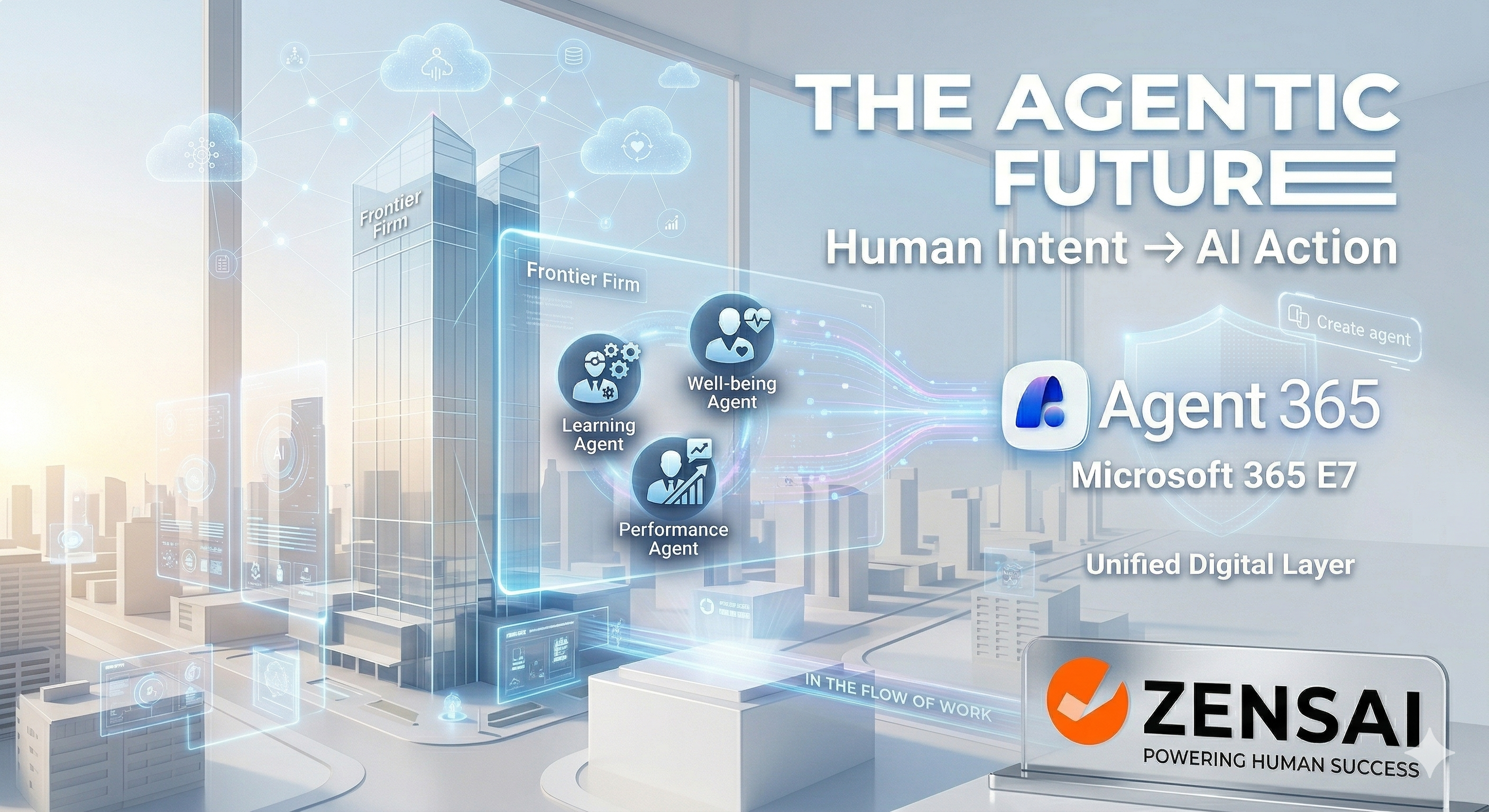
In the Microsoft Partner blog announcing E7’s partner opportunity, Zensai’s Chief Product Officer Andrew Roberts is quoted directly, describing Zensai as an early adopter that is building its Human Success agent on Agent 365 to help businesses measure organizational performance, engagement, and skill development in real time.
That positioning is worth a closer look.
Zensai is not mentioned as a peripheral partner or a future integration. It is positioned as an early adopter building a new category of agent, one focused on measuring and improving how people actually perform, engage, and grow inside the organization. The traditional model for this work has been the static learning management system: assign a course, track completion, file the report. That model was built for compliance, not growth.
The agentic model flips the equation. An agent operating within the E7 trust layer can observe real performance signals, surface skill gaps in real time, recommend development paths based on live organizational data, and do all of this inside the Microsoft 365 environment where work already happens. No context switching. No separate login. No quarterly review cycle that is already stale before it starts.
This is what “Human Success” means in the agentic era. The technology does not replace the human; it removes the friction between a person’s intent to grow and the organization’s ability to support that growth.
What E7 Actually Contains
The suite bundles four components into a single platform, generally available May 1, 2026, at $99 per user per month:
- Microsoft 365 E5 provides the enterprise security and compliance foundation, including Defender, Purview, Intune, and enterprise identity controls.
- Microsoft 365 Copilot embeds AI directly into Word, Excel, PowerPoint, Outlook, and Teams, powered by Work IQ, the intelligence layer that understands how you work and with whom.
- Microsoft Entra Suite extends Zero Trust identity and access controls beyond users to applications, data, and now AI agents.
- Microsoft Agent 365 is the control plane for governing, observing, and securing AI agents across the organization, regardless of which tools or frameworks were used to build them.
Purchased separately, these components would cost approximately $117 per user. The bundle pricing reflects Microsoft’s bet that organizations will adopt faster when trust and intelligence ship together rather than as separate line items.
Why This Matters Beyond the SKU
The licensing details are interesting to procurement teams. The structural shift is interesting to everyone.
Microsoft is making a bet that the enterprise of the near future will manage two workforces: human and digital. Both need identities. Both need security policies. Both need compliance guardrails and audit trails. E7 is the first product to treat that reality as a single, integrated problem rather than two separate ones.
For ISV partners like Zensai, this creates a new design surface. Instead of building standalone applications that sit next to the Microsoft stack, partners can now build agents that operate within the stack, governed by the same trust infrastructure, visible in the same admin console, and grounded in the same organizational intelligence through Work IQ.
The companies that move early on this architecture will define the categories. The ones that wait will integrate with whatever the early movers built.
The Agentic Future is Human First
The instinct when reading about “agent-operated enterprises” is to hear “automated enterprises.” That reading misses the point.
The entire E7 architecture is designed around a specific phrase: “human-led, agent-operated.” The human sets the intent. The human defines the guardrails. The human makes the judgment calls that require context, empathy, and ethical reasoning. The agents handle the execution that requires speed, scale, and consistency.
Zensai’s positioning inside this framework matters because it focuses on the “human-led” half of the equation. An agentic enterprise that moves faster but does not invest in the growth, engagement, and performance of its people is just an efficient machine with a retention problem. The organizations that thrive in this transition will be the ones that use agentic automation to amplify human capability, not replace it.
The platform is live May 1. The agents are being built now. The question for every enterprise leader is not whether this shift is happening, but whether their organization is building the people layer alongside the technology layer. That is the work ahead.