Two Jobs, One Filter: The Stupidly Simple Card That Runs My Week
Most calendars are a graveyard of good intentions. I asked AI to help me engineer my way out, and it gave me something I didn't expect: the obvious.
Most calendars are a graveyard of good intentions. They fill up fast, they stay full, and somewhere in the middle of a Tuesday packed with syncs you didn’t book and reviews that don’t require you, a quiet question surfaces: is any of this actually moving anything?
That question is harder to answer than it sounds. When results are good, nobody cares how you spent your time. When the pressure arrives, suddenly every hour is under audit. The honest answer requires you to stop, reflect, and sometimes cut hard. The uncomfortable part is that most of what fills a calendar is not deliberate. It accumulated.
I decided to stop accumulating and start engineering.
The System That Became a Simpler System
I started this project with an ambitious frame. I wanted to “systems engineer” my role as a sales leader from first principles, build a blueprint, and design my weeks around the 20% of actions that drive 80% of outcomes. I ran the math. I mapped the pipeline. I had a world-class AI architect stress-testing every assumption.
The output was a seven-page document.
Seven pages is not a system. Seven pages is a report that gets read once, filed, and forgotten before the next meeting starts. So I scrapped it.
The real question was simpler. What are the only things that actually move revenue? Not “what does a good sales leader do.” Not “what does the job description say.” What, specifically, mathematically, actually matters?
The answer was two things: fill the pipeline, and help the team close it. Everything else is either infrastructure or noise.
The Card
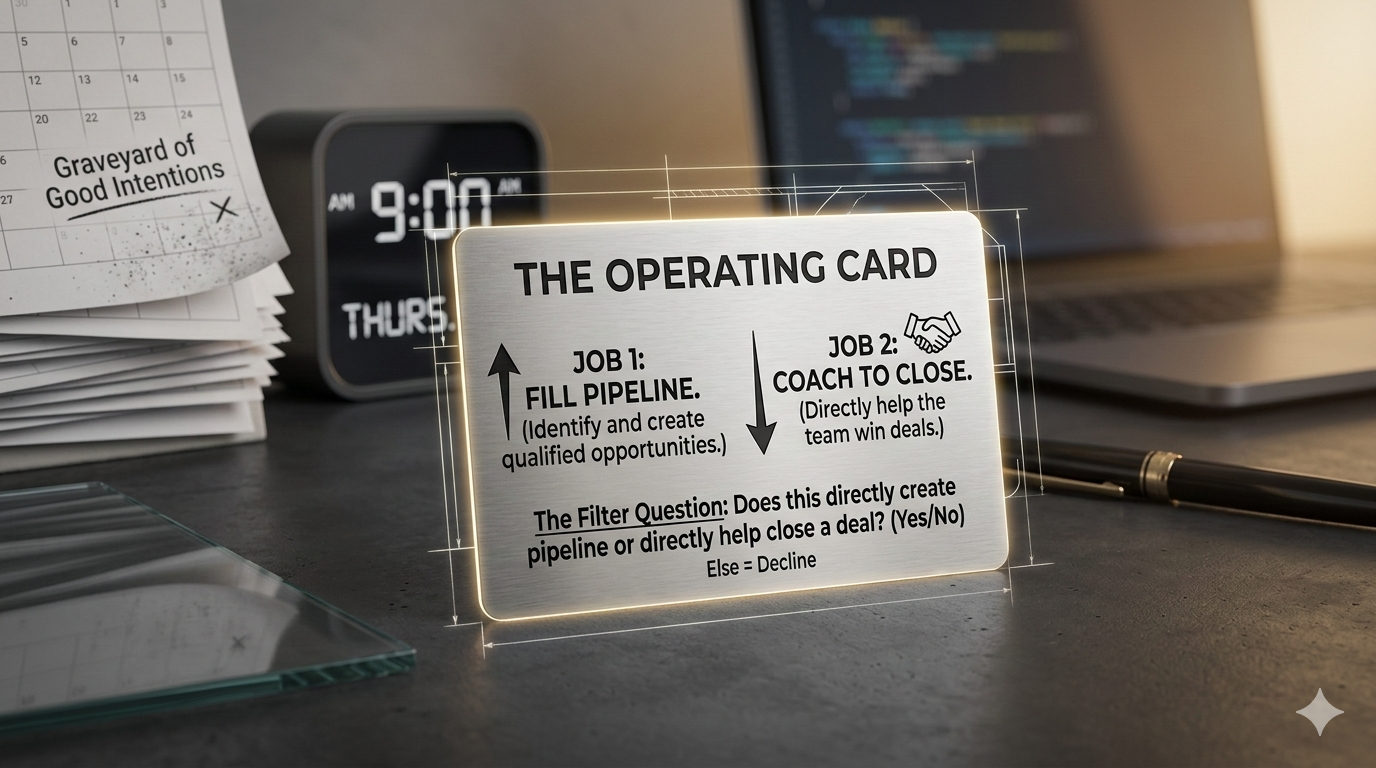
The output of all that engineering is a card. Embarrassingly simple. The kind of thing that takes ten seconds to read and ten minutes to actually sit with.
Two jobs: create qualified pipeline and coach your team to close. One filter question to apply before saying yes to anything: does this directly create pipeline or directly help close a deal? If the answer is no, the default answer is no.
That is the whole framework.
The card also includes a section I call “Feels Important But Isn’t,” which turned out to be the most useful part. It is a short list of activities that carry the weight of productivity without the results: morale meetings that substitute for wins, forecast calls that describe the pipeline without changing it, admin tasks done out of role expectation rather than outcome logic. Writing them down explicitly was clarifying in a way that a seven-page blueprint was not.
You can see the full card here: travis-campbell.com/projects/sales-leader-operating-card
Why the AI Couldn’t Skip This Step
The AI did its job well. It ran the math, identified the leverage points, and built me a detailed blueprint I did not need. That is not a criticism. I asked for complexity and it delivered complexity.
The useful pivot happened when I stopped and said: this is too much. I need something I will actually use at 9am on a Thursday when the calendar is full and the pressure is on. The AI’s job shifted from architect to editor. Strip it. Simplify it. What is the one question I need to ask before I say yes to anything today?
That reframe produced something I have opened every morning this week.
The weekly scorecard is still in progress. The plan is a five-minute Friday ritual, four numbers, one coaching win, one thing to change next week. When that is live, I will write it up.
For now, the card is doing its job. Simple enough to remember. Honest enough to sting a little.